
Your Cart
Loading

SFWH B1–B2 — Advanced French

Move from intermediate French to confident, independent communication.

A complete advanced French system designed to help you think, speak and perform with greater confidence, accuracy and independence.

Explore B1–B2
Advanced French System

Develop the language ability required for higher-level performance.

Strengthen grammar, expand vocabulary, improve comprehension and develop the speaking and writing skills needed for more demanding academic, professional and real-world communication.

The program moves from B1 intermediate communication toward B2 upper-intermediate performance, with increasing fluency, precision and independence.

B1 Intermediate

Express experiences, explain ideas and manage familiar situations with increasing independence.

B2 Upper-Intermediate

Communicate with greater fluency, precision and confidence across more complex situations.

01 Fluent, Structured Communication

Develop longer, more organized responses and communicate ideas, explanations and opinions with greater clarity.

02 Advanced Language Control

Strengthen grammar, vocabulary and sentence structure so your French becomes more precise and flexible.

03 Listening, Reading & Interpretation

Build the ability to follow longer texts, discussions and explanations without depending on word-for-word translation.

04 Professional & Assessment Readiness

Prepare your underlying French for workplace communication, advanced assessments and future exam-specific preparation.

Skills Covered
Grammar Vocabulary Listening Speaking Reading Writing
B1 Development Build greater independence.
B2 Performance Communicate with greater precision.
Advanced Communication Academic, professional and real-world French.
B1–B2 Curriculum Explorer

Browse the intermediate and advanced curriculum. Choose a level or search for a topic.

Complete B1–B2 Pathway 3 groups · 24 sections · 362 topics
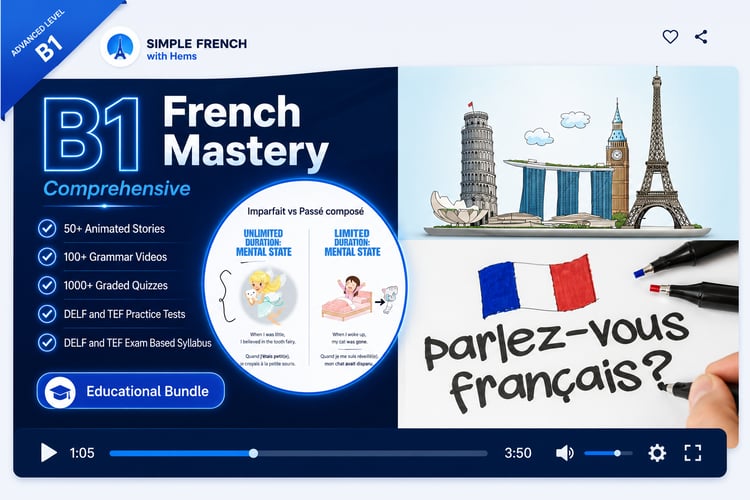
B1 — Intermediate French 9 sections · 144 topics
Course Introduction 6 topics
  • Welcome to the B1 course
  • Is it hard to learn French?
  • Benefits of the French language
  • French-language examinations
  • Introduction to Hems
  • Resources for studying
Section 1 — Passé Composé and Imparfait 17 topics
  • Section 1 vocabulary resource
  • Passé composé revision — Part 1
  • Passé composé revision — Part 2
  • Passé composé revision — Part 3
  • Passé composé revision — Part 4
  • Passé composé revision — Part 5
  • Passé composé revision — Part 6
  • Verbs conjugated with both avoir and être
  • Verbs whose meaning changes in passé composé
  • Uses of passé composé
  • Irregular reflexive verbs
  • Imparfait revision — Part 1
  • Imparfait revision — Part 2
  • Imparfait revision — Part 3
  • Passé composé versus imparfait — Part 1
  • Passé composé versus imparfait — Part 2
  • Section 1 vocabulary quiz
Section 2 — Plus-que-parfait and Passé Simple 20 topics
  • Section 2 vocabulary resource
  • Introduction to plus-que-parfait
  • Gender-based endings in plus-que-parfait
  • Past participles in plus-que-parfait
  • Imparfait auxiliaries in plus-que-parfait
  • Plus-que-parfait with avoir and a noun object
  • Plus-que-parfait with a direct-object pronoun
  • Plus-que-parfait with an indirect-object pronoun
  • Plus-que-parfait with être and movement verbs
  • Plus-que-parfait with reflexive verbs
  • Plus-que-parfait with direct-object pronouns
  • Plus-que-parfait with indirect-object pronouns
  • Introduction to passé simple
  • Passé simple with regular -ER verbs
  • Spelling changes with -ER verbs in passé simple
  • Passé simple with regular -RE verbs
  • Passé simple with regular -IR verbs
  • Irregular passé-simple verbs with past-participle patterns
  • Irregular passé-simple verbs without past-participle patterns
  • Section 2 vocabulary quiz
Section 3 — Future Tenses 15 topics
  • Section 3 vocabulary resource
  • Revision of the simple future
  • Simple-future verb changes
  • Irregular simple-future verbs
  • Future time expressions
  • Uses of the simple future
  • Revision of futur proche
  • Introduction to futur antérieur
  • Futur antérieur with avoir
  • Futur antérieur with être
  • Futur antérieur with conjunctions
  • Futur simple versus futur proche
  • Futur simple versus futur antérieur
  • Comparison of all three future structures
  • Section 3 vocabulary quiz
Section 4 — Conditionals and Hypothetical Language 18 topics
  • Section 4 vocabulary resource
  • Introduction to the conditional
  • Conditional versus imparfait
  • Conditional endings for -ER verbs
  • Conditional endings for -RE verbs
  • Conditional endings for -IR verbs
  • Irregular conditional stems
  • Uses of the present conditional — Part 1
  • Uses of the present conditional — Part 2
  • Uses of the present conditional — Part 3
  • Uses of the present conditional — Part 4
  • Introduction to si clauses
  • Si clauses in the present conditional
  • Que clauses in conditional sentences
  • Mieux expressions in the conditional
  • Conditionals used for allegations
  • Additional allegation verbs
  • Section 4 vocabulary quiz
Section 5 — The Subjunctive 18 topics
  • Section 5 vocabulary resource
  • Introduction to the subjunctive
  • Subjunctive sentence structure
  • Subjunctive with regular -ER verbs
  • Subjunctive with regular -RE verbs
  • Subjunctive with regular -IR verbs
  • Subjunctive triggers
  • Additional subjunctive triggers
  • Double-stem subjunctive verbs
  • Regular verbs with double subjunctive stems
  • Additional double-stem verbs
  • Irregular-stem subjunctive verbs
  • Irregular verbs using regular subjunctive stems
  • Subjunctive writing activity A
  • Subjunctive writing activity B
  • Subjunctive writing activity C
  • Writing activity sample answers
  • Section 5 vocabulary quiz
Section 6 — Possessive and Relative Pronouns 14 topics
  • Section 6 vocabulary resource
  • Revision of possessive adjectives
  • Revision of French pronouns
  • Introduction to possessive pronouns
  • Possessive pronouns: ours, yours and theirs
  • Possessive pronouns with non plus and aussi
  • Possessive pronouns with ce n’est pas
  • Numbers used as pronouns
  • Ordinal numbers and building floors
  • Introduction to relative pronouns
  • Relative pronouns meaning which
  • Advanced forms meaning which
  • Relative pronouns où and dont
  • Section 6 vocabulary quiz
B1 Reading, Writing, Listening and Speaking Tests 24 topics
  • Reading test 1
  • Reading test 2
  • Reading test 3
  • Reading test 4
  • Reading test 5
  • Reading test 6
  • Writing test 1
  • Writing test 2
  • Writing test 3
  • Writing test 4
  • Writing test 5
  • Writing test 6
  • Listening test 1 with audio and quiz
  • Listening test 2 with audio and quiz
  • Listening test 3 with audio and quiz
  • Listening test 4 with audio and quiz
  • Listening test 5 with audio and quiz
  • Listening test 6 with audio and quiz
  • Speaking assignment 1
  • Speaking assignment 2
  • Speaking assignment 3
  • Speaking assignment 4
  • Speaking assignment 5
  • Speaking assignment 6
B1 Answer Resources 12 topics
  • Writing test sample answer 1
  • Writing test sample answer 2
  • Writing test sample answer 3
  • Writing test sample answer 4
  • Writing test sample answer 5
  • Writing test sample answer 6
  • Speaking test sample animation 1
  • Speaking test sample animation 2
  • Speaking test sample animation 3
  • Speaking test sample animation 4
  • Speaking test sample animation 5
  • Speaking test sample animation 6
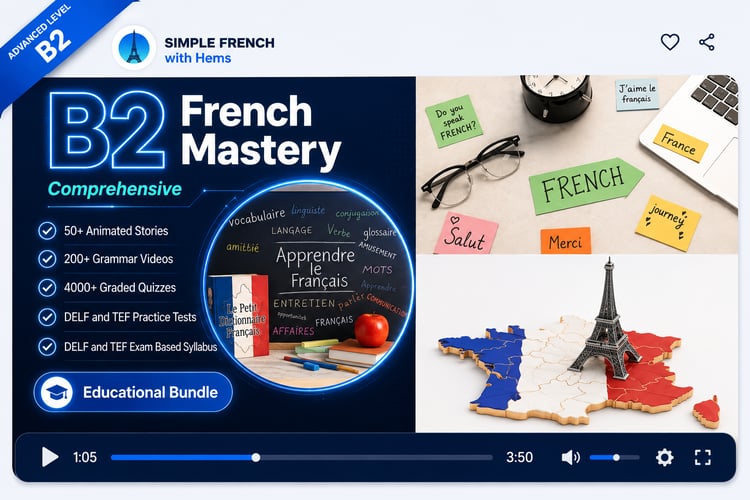
B2 — Advanced French 10 sections · 169 topics
Course Introduction 6 topics
  • Welcome to the B2 course
  • Preparing for advanced French
  • Benefits of advanced French study
  • French-language examinations
  • Introduction to Hems
  • B2 learning resources
Section 1 — Past Conditional and Si Clauses 23 topics
  • Section 1 vocabulary resource
  • Revision of conditional structures
  • Conditional endings
  • Conditional forms of avoir and être
  • Revision of past participles
  • Introduction to the past conditional
  • Past conditional with avoir
  • Past conditional with être
  • Past conditional with regular -ER verbs
  • Past conditional with regular -IR verbs
  • Past conditional with regular -RE verbs
  • Past conditional with reflexive verbs
  • Il y a in past-conditional contexts
  • Introduction to si clauses
  • Revision of plus-que-parfait
  • Si with plus-que-parfait
  • Types of si constructions
  • Si meaning if versus whether
  • Verbs followed by si
  • Indirect disclosure using que
  • Indirect disclosure using si
  • Could in past-conditional sentences
  • Should in past-conditional sentences
Section 2 — Past Subjunctive 29 topics
  • Section 2 vocabulary resource
  • Subjunctive versus indicative revision
  • Revision of subjunctive formation
  • Introduction to the past subjunctive
  • Past subjunctive with avoir
  • Past subjunctive with noun objects
  • Past subjunctive with direct-object pronouns
  • Past subjunctive with indirect-object pronouns
  • Past subjunctive with être
  • Movement verbs in the past subjunctive
  • Reflexive verbs in the past subjunctive
  • Reflexive verbs with indirect objects
  • Wishes and requests
  • Permission and prohibition
  • Needs and expectations
  • Joy and surprise
  • Sadness and displeasure
  • Fear and regret
  • Necessity and importance
  • Possibility and desirability
  • Impossibility
  • Expressions of doubt
  • Using espérer
  • Subjunctive with similar subjects
  • Ne pléonastique
  • Using être heureux
  • Using heureusement que
  • Using probable que
  • Expressions that do not require the subjunctive
Section 3 — Conjunctions and Complex Clauses 12 topics
  • Section 3 vocabulary resource
  • Conjunctions followed by the subjunctive
  • Conjunctions that always require the subjunctive
  • Conjunctions that do not require the subjunctive
  • Thinking verbs and mood selection
  • Revision of relative pronouns
  • Relative clauses using the subjunctive
  • Subjunctive after commands
  • Indicative versus subjunctive in complex clauses
  • Expressing certainty and uncertainty
  • Expressing judgement and evaluation
  • Connecting advanced arguments
Section 4 — Present Infinitive 11 topics
  • Section 4 vocabulary resource
  • Introduction to the present infinitive
  • General uses of the infinitive
  • Infinitives following à
  • Infinitives following de
  • Infinitives requiring no preposition
  • Nominalized infinitives
  • Infinitives after impersonal expressions
  • Negation with infinitives
  • Infinitives in complex sentences
  • Combining infinitives with object pronouns
Section 5 — Indefinites, Negation and Causative Faire 14 topics
  • Section 5 vocabulary resource
  • Introduction to French indefinite forms
  • Indefinite adjectives
  • Indefinite pronouns
  • Indefinite expressions in complex sentences
  • Indefinites with negation
  • Advanced negative structures
  • Double-negative structures
  • Introduction to causative faire
  • Using faire to express caused actions
  • Causative faire with a named agent
  • Causative faire with object pronouns
  • Causative faire in different tenses
  • Integrating causative structures into complex clauses
Section 6 — Present Participles and the Gerund 19 topics
  • Section 6 vocabulary resource
  • Introduction to French participles
  • Understanding French equivalents of -ing
  • Present participles with -ER verbs
  • Present participles with -RE verbs
  • Present participles with -IR verbs
  • Present participles with -CER verbs
  • Present participles with -GER verbs
  • Irregular present participles
  • Uses of the present participle
  • Introduction to the gerund with en
  • Gerund for simultaneous actions
  • Exceptions involving the gerund
  • Gerund expressing reason
  • Gerund expressing manner
  • Gerund expressing immediacy
  • Gerund expressing condition
  • Perfect participles using ayant
  • Perfect participles using étant
Section 7 — Passive Voice 23 topics
  • Section 7 vocabulary resource
  • Introduction to the passive voice
  • Identifying the agent
  • Passive constructions using par
  • Passive constructions using de
  • Passive voice in the present tense
  • Passive voice in the imparfait
  • Passive voice in the simple future
  • Passive voice in the conditional
  • Passive voice in the subjunctive
  • Passive voice with the infinitive
  • Passive voice in passé simple
  • Passive voice in the past conditional
  • Passive voice in futur antérieur
  • Passive voice in passé composé
  • Passive voice in the past subjunctive
  • Passive voice in plus-que-parfait
  • Passive voice with the past infinitive
  • Passive voice in passé récent
  • Passive voice in futur proche
  • Direct-object pronouns in passive structures
  • Indirect-object pronouns in passive structures
  • Verbs and prepositions used with passive constructions
B2 Reading, Writing, Listening and Speaking Tests 24 topics
  • B2 reading mock assessment 1
  • B2 reading mock assessment 2
  • B2 reading mock assessment 3
  • B2 reading mock assessment 4
  • B2 reading mock assessment 5
  • B2 reading mock assessment 6
  • B2 writing mock assessment 1
  • B2 writing mock assessment 2
  • B2 writing mock assessment 3
  • B2 writing mock assessment 4
  • B2 writing mock assessment 5
  • B2 writing mock assessment 6
  • B2 listening mock assessment 1
  • B2 listening mock assessment 2
  • B2 listening mock assessment 3
  • B2 listening mock assessment 4
  • B2 listening mock assessment 5
  • B2 listening mock assessment 6
  • B2 speaking assignment 1
  • B2 speaking assignment 2
  • B2 speaking assignment 3
  • B2 speaking assignment 4
  • B2 speaking assignment 5
  • B2 speaking assignment 6
B2 Answer and Model-Response Resources 8 topics
  • B2 writing model responses
  • Advanced paragraph models
  • Formal writing examples
  • Opinion-response examples
  • Argument-structure examples
  • Animated B2 speaking sample answers
  • Model responses for advanced speaking prompts
  • Vocabulary and expression support
Resources — Included B1–B2 Resources 5 sections · 49 topics
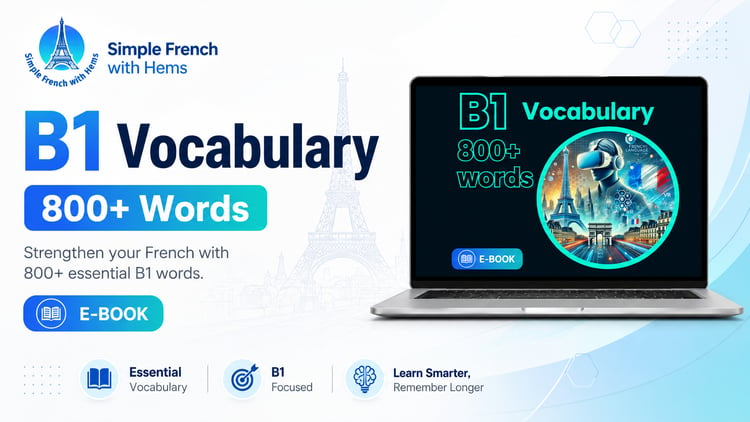
B1 Vocabulary Book 8 topics
  • Intermediate vocabulary development
  • Topic-based vocabulary
  • Expressions for everyday communication
  • Vocabulary for social situations
  • Vocabulary for education and work
  • Vocabulary for travel and services
  • Vocabulary for opinions and experiences
  • Independent vocabulary review
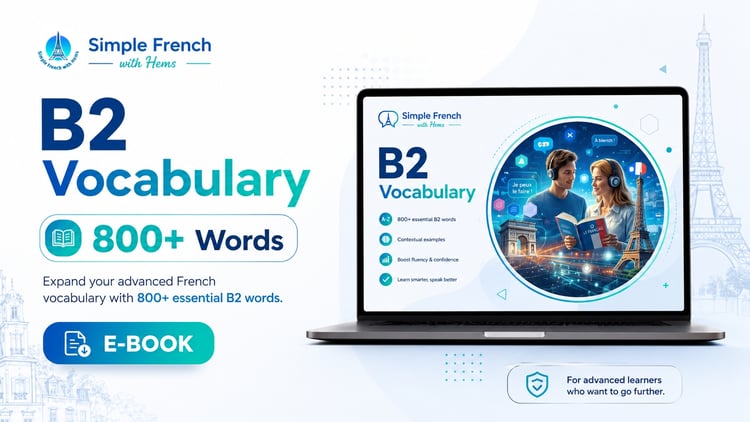
B2 Vocabulary Book 11 topics
  • More than 800 B2 vocabulary words
  • More than 20 vocabulary themes
  • Family and relationships
  • Food and everyday life
  • Travel and transportation
  • Professions and workplace language
  • Social and cultural themes
  • Advanced communication vocabulary
  • Exam-focused terminology
  • Vocabulary for DELF and TEF preparation
  • Practical real-world application
Four-Skill Assessment System 9 topics
  • Reading-comprehension tests
  • Writing assignments
  • French listening audio
  • Listening-comprehension quizzes
  • Speaking assignments
  • Writing sample answers
  • Animated speaking sample answers
  • Level-based vocabulary quizzes
  • Exam-style practice scenarios
Self-Paced Learning System 12 topics
  • Recorded instructor-led lessons
  • Grammar explanations
  • Downloadable vocabulary resources
  • Interactive exercises
  • Practice quizzes
  • Reading activities
  • Writing activities
  • Listening activities
  • Speaking activities
  • Repeatable lessons
  • Ability to revisit B1 while studying B2
  • Study without fixed semester deadlines
Lifetime Course Access 9 topics
  • Lifetime access to included B1 lessons
  • Lifetime access to included B2 lessons
  • Lifetime access to included videos
  • Lifetime access to included quizzes
  • Lifetime access to included tests
  • Lifetime access to included learning tools
  • Long-term revision
  • Return to difficult topics when needed
  • Continue studying after completing the pathway
No matching curriculum topics found.

Why Choose the B1–B2 Pathway?

Continue from intermediate to upper-intermediate French through one connected pathway, with both levels and their supporting resources already available as you progress.

Buying B1 & B2 Separately B1–B2 Pathway
Make a second purchase later ✓One continuous progression
Plan each level separately ✓B1 → B2 progression already mapped
Review each level's resources independently ✓Supporting materials organized together
Decide what to do after completing B1 ✓B2 continuation already available
Manage two separate level purchases ✓Access both stages through one pathway

Choose a plan

Victory in Stages

CA$188.88
per month for 10 months
  • Begin the complete B1 to B2 bundle without paying the full amount upfront
  • Spread the cost across 10 manageable monthly payments
  • Access a structured French pathway covering both B1 and B2
  • Receive lifetime access, so your lessons and learning tools remain available after the payment period ends
  • Study at your own pace rather than following a fixed academic schedule
  • Work through advanced French concepts gradually, with the ability to revisit lessons whenever needed
  • Avoid repeated registration and administrative steps as you move from one level to the next
  • Benefit from a complete self-paced learning system with videos, quizzes, tests, and digital learning tools
  • A practical choice for learners who want to begin immediately while keeping the cost more flexible over time
  • Well suited to learners who want long-term B1-to-B2 development without a large upfront payment

Start now, spread the cost comfortably, and keep your full B1 to B2 bundle for life.

One Time Victory

CA$1,675.55
  • Save CA$213.25 compared with the 10-month payment plan
  • Unlock the complete B1 to B2 bundle with one payment
  • Progress through both intermediate and advanced French in one continuous learning path
  • Avoid purchasing B1 and B2 separately as your level increases
  • Receive lifetime access to all included lessons, videos, quizzes, tests, and learning tools
  • Strengthen grammar, vocabulary, listening, reading, writing, and speaking across multiple higher-level stages
  • Continue reviewing earlier material while advancing into more complex B2 content
  • Learn at your own pace without admission procedures, registration delays, or fixed academic-term deadlines
  • Avoid the inconvenience of re-enrolling each time you are ready for the next level
  • Ideal for serious learners who want the lowest total price, uninterrupted access, and a full B1-to-B2 progression in one investment

Invest once, save more, and secure a complete B1 to B2 pathway with lifetime access.
WhatsApp