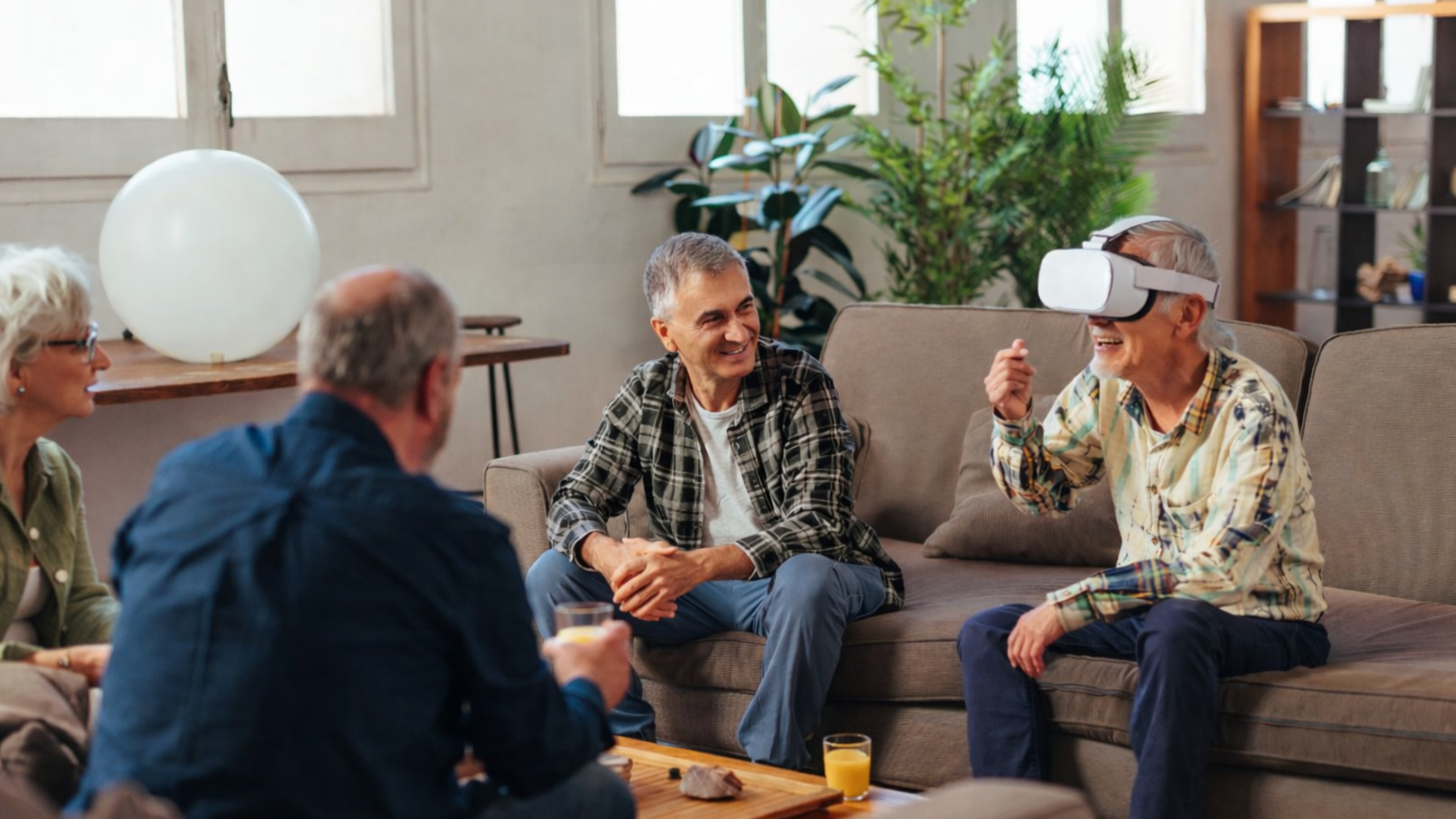
Give older adults something new to notice, recall and express.
Immersive Mind & Memory Program (IMMP) is a facilitator-led program for older adults that combines simple French vocabulary, listening, writing, drawing, recall, conversation and short seated VR experiences. It is especially relevant to senior-serving organizations looking for structured cognitive engagement for older adults who may be experiencing memory or thinking changes, including mild cognitive impairment (MCI). Participants are not being asked to become French learners or independent VR users. The unfamiliar language and technology are used as structured new stimuli inside a guided group activity, not as clinical treatment.
Built for older adults
Seated & facilitator-led
French = stimulus, not fluency
VR = one part of the activity
Inside the program
Why active cognitive engagement matters when older adults are experiencing memory or thinking changes.
Mild cognitive impairment (MCI) means an older adult has more memory or thinking difficulty than is typical for people the same age, while everyday independence can still be largely preserved.
IMMP is built around active, novel, guided engagement - not passive VR watching.
The goal is to give senior-serving organizations a structured way to combine immersion, language, recall, conversation and practical technology education in one facilitator-led program.
Why MCI is part of the design conversation
MCI is not the same as dementia, and not everyone with MCI progresses to dementia. It is, however, an important reason to think carefully about cognitive engagement, novelty, social connection, usability and how older adults interact with technology.
Important program boundary
IMMP is educational and recreational. It does not diagnose, treat, reverse or claim to cure MCI. The research below explains the design rationale behind the program; it is not proof of a clinical treatment outcome.
Why VR for older adults?
Because immersion can create interaction, presence and social connection that a passive screen cannot.
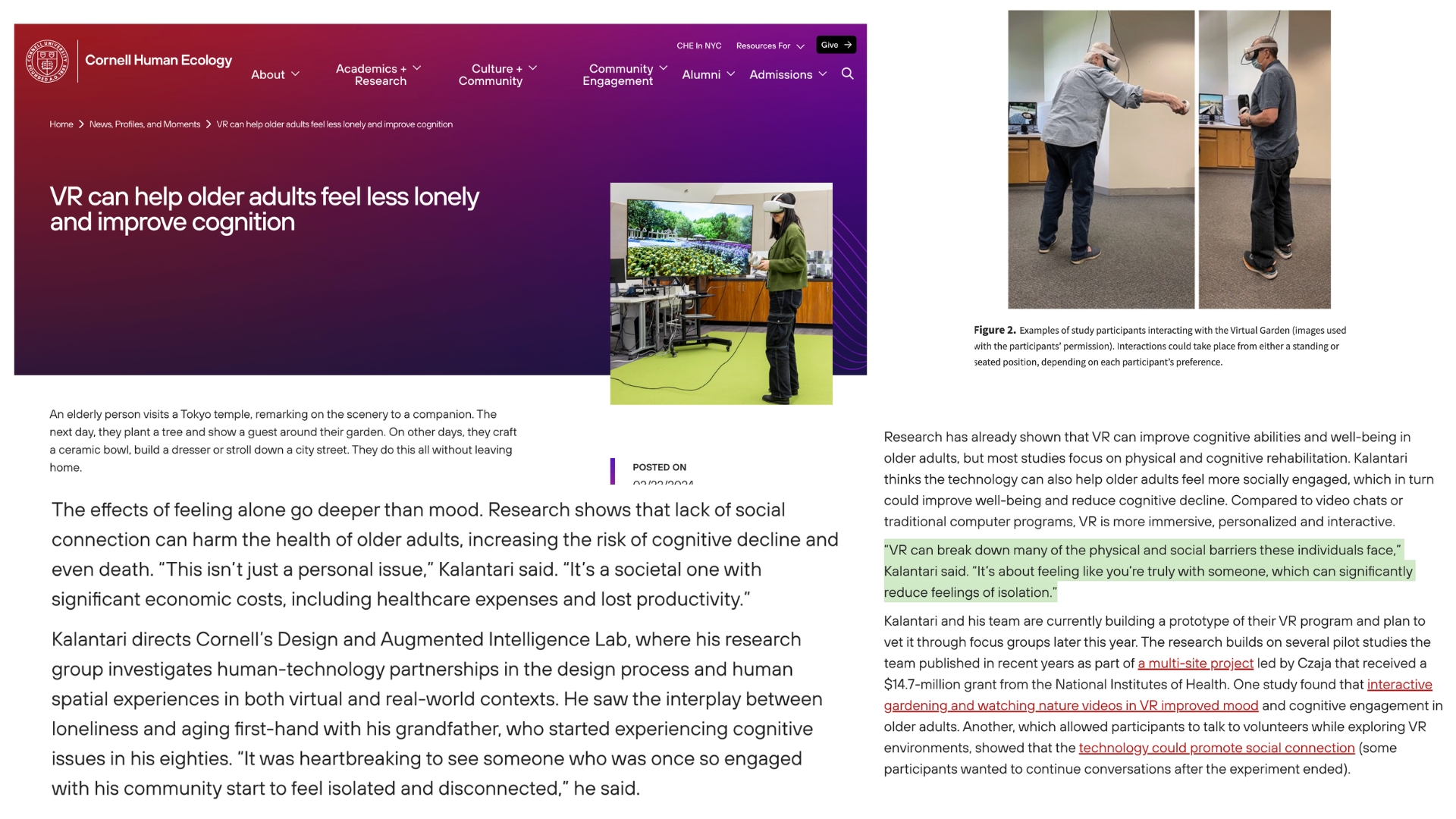
Cornell research is studying socially engaging VR with older adults, including people with mild cognitive impairment. Their work describes VR as more immersive and interactive than conventional video communication and examines how it can reduce physical or social barriers while supporting engagement.
Why this matters for IMMP: VR is not included for a "wow factor." It creates a guided context in which a participant can notice, respond, speak and remain connected to a facilitator and group.
Because demanding new-skill learning asks the brain to do more than simply observe.
In the University of Texas at Dallas Synapse Project, older adults who spent sustained time learning demanding new skills showed stronger episodic-memory improvement than lower-demand receptive activity groups.
Why this matters for IMMP: the experience deliberately asks participants to listen, retrieve, speak, write, draw, recognize, respond and repeat. French is one practical source of novelty because it can make a familiar room cognitively unfamiliar without requiring the participant to become a language student.
No. Universities and research centres in Canada and the United States are actively studying VR, mixed reality, AI, serious games, spatial-memory training, conversational systems and other technology-supported approaches for older adults, MCI and dementia-related needs. The common direction is important: older adults are increasingly being studied as active participants in technology-mediated experiences, not only as passive viewers.
University of Alberta + Glenrose Rehabilitation Hospital
The Glenrose Grocery Game uses a familiar shopping task to study memory, attention, problem-solving, errors and everyday-function-related performance in older adults, including research focused on MCI detection.
Researchers are examining how AI and mixed reality can affect older adults' cognitive experiences and social participation, including ways technology might reduce cognitive, physical and social barriers.
UHN's KITE / DATE Lab researchers have studied mixed-reality systems, visual and audio cues, games and everyday-task support for people living with cognitive impairment and dementia.
Researchers are using technology and machine learning to study mobility patterns and support people living with cognitive impairment and dementia, including work involving the GuardIO platform.
A 12-week spatial-memory training study is specifically examining cognition, spatial memory and hippocampal-related outcomes in adults diagnosed with mild cognitive impairment.
PennAITech is a National Institute on Aging-funded collaboratory developing and evaluating AI and technology for healthy aging and for older adults living with Alzheimer's disease and related dementias.
CREATE V includes large-scale work on VR for cognitive and social engagement in aging adults, along with technology projects designed to support people with mild cognitive impairment.
A 2026 research project is examining the feasibility of immersive VR cognitive training for older adults with mild cognitive impairment, with particular interest in thinking skills and spatial awareness.
Current projects include AI-CONECT, a conversational-AI study for socially isolated older adults with MCI, as well as other technology studies involving older adults with cognitive concerns.
The SYNERGIC program has studied computerized cognitive training together with exercise in older adults with MCI, reinforcing the broader research interest in active, multidomain cognitive engagement.
Examples of related research directions - not affiliations with, endorsements of, or clinical validation of IMMP.
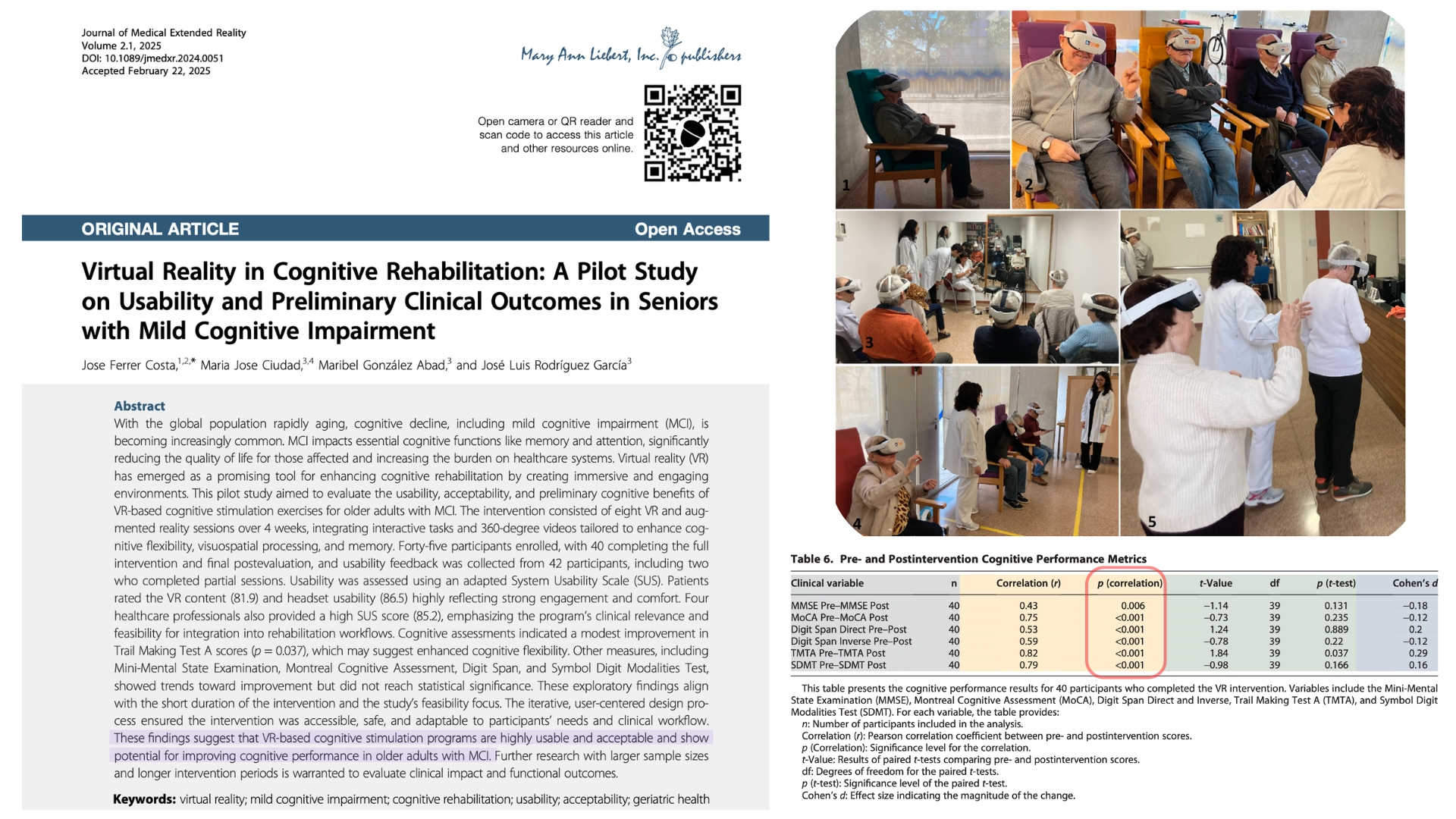
IMMP supports the direction of Mild Cognitive Impairment (MCI) Research.
Example research visual connected to virtual reality, seniors and Mild Cognitive Impairment.
The connection is practical: IMMP gives older adults something new to learn and something active to do with that new information.
French provides an unfamiliar stimulus for many English-speaking participants, while the program asks them to read, listen, write, speak, draw, retrieve, recognize and respond inside familiar everyday environments.
This matters to the Mild Cognitive Impairment research conversation because the activity is not limited to watching VR. Participants repeatedly work with new information across several modes, move between the headset and facilitator-led activities, and revisit the same material over time. That creates a structured cognitive-engagement format that can be relevant to centres and researchers interested in novelty, recall, participation and repeated learning in older adults.
Research boundary: this alignment supports the program's research rationale and potential use in cognitive-engagement settings.
How IMMP turns that rationale into an active program.
The program is designed to make the participant do something with the stimulus. The headset is only one part of the process; speech, retrieval, listening, writing, drawing, familiar everyday actions and repetition create the wider cognitive-engagement structure.
01Speak to AI - do not just watch it.
Selected activities use conversational AI so the participant has to answer, try again and respond rather than remain a passive viewer.
Hover or tap to flip
02Point, hear and recognize everyday objects.
Objects such as a chair, lamp, table or household item can be named, heard and revisited in context so the environment becomes part of the activity.
Hover or tap to flip
03Comfort first - not visual overload.
The experience is seated, light and deliberately calmer than a high-speed game. Familiar rooms and everyday objects are used to make the technology feel less threatening.
Hover or tap to flip
04French creates a controlled new stimulus.
For many English-speaking participants, a short French word is unfamiliar enough to require attention while remaining small enough to hear, write, draw, retrieve and say back.
Hover or tap to flip
05Your voice controls progression.
In selected voice-controlled moments, the experience waits for a spoken response. If the participant does not speak, the activity does not simply roll forward like a passive travel video.
Hover or tap to flip
06Use familiar daily-life actions.
Playing a piano, feeding a dog, brushing teeth, using a toaster and moving through familiar rooms make the task understandable while the language or prompt remains new.
Hover or tap to flip
07Get AI feedback and another attempt.
Participants can receive feedback on selected spoken responses and try again, turning mistakes into another guided interaction rather than ending the activity.
Hover or tap to flip
08ARS + ICLE extend the activity outside VR.
ARS (Active Recall Sessions) and ICLE (Integrated Cognitive Listening Activities) combine recall, listening, reading, writing, drawing and spoken response so the session is not dependent on the headset.
Hover or tap to flip
09Repeat across a structured room cycle.
The same room and vocabulary can be revisited across repeated sessions. Repetition is intentional: participants encounter, retrieve and use the same material again instead of seeing it once and moving on.
Hover or tap to flip
What IMMP brings to the centre beyond the headset.
01Centre-facing engagement record
Across a recurring series, the centre can receive a non-clinical overview of attendance, participation, activity exposure, responses and delivery adjustments from earlier to later sessions. It is not a cognitive test.
02Complimentary practical AI literacy
Participating centres can also receive practical AI education for older adults, including demonstrations of voice cloning, face cloning, synthetic media and voice-generated songs so participants can better recognize how modern AI can imitate real people.
03We bring the program to the centre
Our Calgary-based team brings the technology, guided cognitive activities and AI-literacy education on-site. Participants do not need to travel to a lab or learn to operate the system independently.
Research interpretation: these studies support design directions such as social immersion, active/new-skill engagement, usable technology, cognitive participation and mixed-reality research. They do not establish that IMMP treats MCI or produces a guaranteed clinical outcome.
IMMP in the 2026 Field Law Community Fund
The Immersive Mind & Memory Program (IMMP) was publicly listed in the
2026 Field Law Community Fund Northern Alberta ideas gallery. This screenshot is included
as part of the program's public community-engagement record.
Built for older adults
One guided space. More than one way to participate.
Immersive Mind & Memory Program (IMMP) is designed around the participant, not the headset. The facilitator handles the technology while each person participates at a comfortable level. That flexibility is especially relevant when a group may include older adults with mild cognitive impairment (MCI) or other cognitive concerns.
01 | GUIDED THROUGHOUT
The facilitator stays involved.
Setup, pacing and VR transitions are guided with the participant. Nobody handles the technology alone.
Facilitator-ledSupported throughout
02 | SIT COMFORTABLY
Seated participation is fully supported.
Participants can complete the activity while seated. Room-scale walking is not required.
Seated optionNo room-scale walking
03 | STAND IF PREFERRED
Standing can be an option too.
Standing is also an option when appropriate, with the facilitator nearby.
Optional standingFacilitator nearby
04 | HEADSET OPTIONAL
Listening and observing still count.
A participant can follow the group without wearing the headset. VR remains optional.
Headset optionalGroup participation
Participation stays flexible
Choose the level that fits: seated, standing, brief VR, or group participation without the headset.
Guided throughout
01 / 04
01 / 04
Details concerning our Immersive Mind & Memory Program (IMMP)A closer look at the structure, delivery and immersive VR experience used in our Immersive Mind & Memory Program (IMMP) for older adults.
Program boundary. Immersive Mind & Memory Program (IMMP) uses unfamiliar language, recall, discussion and optional immersive context as structured brain-engagement activities, including in senior-serving settings where MCI may be part of the population served. It is an educational and recreational program and is not presented as medical treatment, MCI diagnosis or proof of cognitive improvement.
Video Testimonials & Session Highlights
Real participant feedback, coordinator perspectives and in-session moments from our guided VR workshops.
Real participantsReal pilot sessionsEdmonton community settingsClick any video to watch
Hosted event evidence
A public event page documenting the session
This event-page screenshot is included as supporting evidence that the event was
publicly presented and hosted. It also provides context around why the
session was held and where the experience took place.
Featured session review
IMMP Session Review | GEF Seniors Housing - Strathcona Place
Senior participant
Senior Participant | SEESA VR Pilot Session
Program coordinator
SEESA Program Coordinator | VR Workshop Feedback
Pilot review
VR French Workshop Pilot Review | Edmonton Unlimited
Participant testimonial
Participant Testimonial | VR Pilot at Garneau Public School
VR Pilot Review at Garneau Public School | Event Leader Insights
What participants actually do
One unfamiliar French word becomes six different actions.
The word is raw material for the activity, not a vocabulary target that has to be mastered. Participants hear it, write it, draw it, recall it, meet it inside an immersive context and then talk about it together.
01Listen first
Hear it
The participant meets the word by listening. No memorization target appears yet.
02Written response
Write it
The participant writes the word or a short response. The stimulus now has a visible form.
03Visual response
Draw it
A quick drawing links the word to an image. That makes recall easier later.
04Spoken response
Say it back
The participant answers aloud. Speech appears after several lower-pressure steps.
05Immersive moment
Recognize it in context
The participant meets the same idea inside VR. The headset adds context, not pressure.
06Discussion
Talk about it
The participant discusses the experience with the group. VR stays part of a larger social activity.
What if VR feels difficult, unfamiliar - or makes someone dizzy?
That is a real concern. The program does not assume that every older adult
will tolerate long VR use or learn the hardware independently. Comfort and supervision
come before completing the headset portion. The low-sensory-load, facilitator-led format is also intended to reduce unnecessary interface demands when a centre is serving participants with mild cognitive impairment (MCI) or other cognitive concerns.
01
Seated first
The senior-focused headset activity is designed to be completed while seated. Room-scale walking is not required.
02
Short, guided exposure
The VR portion is only one part of the session. Participants are not expected to stay immersed for a long continuous period.
03
A facilitator stays with the participant
Headset fit, controls, prompts and the transition into the experience are handled with the participant - not left for them to figure out alone.
04
Pause or stop immediately
If a participant feels uncomfortable, disoriented or dizzy, the headset can be removed. Finishing the VR portion is never more important than comfort.
05
The group activity can continue
Listening, writing, drawing, recall and discussion do not depend on wearing the headset. Other participants can also follow the shared display and remain involved.
Our rule: comfort before completion.If the headset is not comfortable for a participant, the session can continue through the non-headset activities. VR is a tool inside the program - not a requirement to prove anything.
French is the stimulus - not the outcome.
Learning a new language and encountering a new stimulus are two different objectives.
Immersive Mind & Memory Program (IMMP) does not ask older adults to study grammar, complete levels or work toward fluency.
It uses small amounts of unfamiliar French as material for a guided attention-and-recall activity.
!= The distinction that matters
Not the goalLearn French.
The purposeDo something new with an unfamiliar stimulus.
Not a French courseNo fluency target | no grammar progression | no exam pathway | no requirement to retain a large vocabulary list
->
French as a new stimulusShort unfamiliar sounds and words give the participant something new to hear, write, draw, retrieve, recognize and talk about.
Q1
Why use unfamiliar French words?
Because a short unfamiliar word is new enough to require attention, but small enough to use inside a guided activity. For an older adult - including someone living with MCI - IMMP uses French as one practical way to create novelty and active response without requiring mastery of a language system. The research supports the broader principle of demanding new-skill engagement; it does not establish French as an MCI treatment.
Q2
Why include VR as well?
VR adds another unfamiliar element: a new technology and a new context. It can make the same stimulus appear in a different environment without turning the whole session into a VR game.
Q3
Why write and draw instead of only listening?
Because the same new item is approached in different ways. The participant hears it, produces something with the hand, creates a visual representation and later tries to retrieve or describe it.
Q4
Why not just use a traditional game?
Traditional games can still be useful. Immersive Mind & Memory Program (IMMP) offers a different type of novelty without depending on fast reactions, competition or independent technology use. The emphasis is guided participation and conversation.
What we are trying to encourage:
attention, curiosity, active response, recognition, retrieval and conversation around something new.
The program is educational and recreational; it is not presented as treatment, diagnosis or proof of cognitive improvement.
See the program with real older adults.
The concept is easier to understand when you can see the delivery:
seated headset use, facilitator support, shared-screen visibility, group participation and feedback from real senior-community sessions.
8+ documented pilot and demonstration settings as of August 2026Documented field delivery across senior, community and public demonstration settings.
SEESA evidenceSenior participant and program-coordinator feedback from actual delivery.
External recognitionSimple French with Hems was selected for Alberta Catalyzer Velocity Cohort 18.
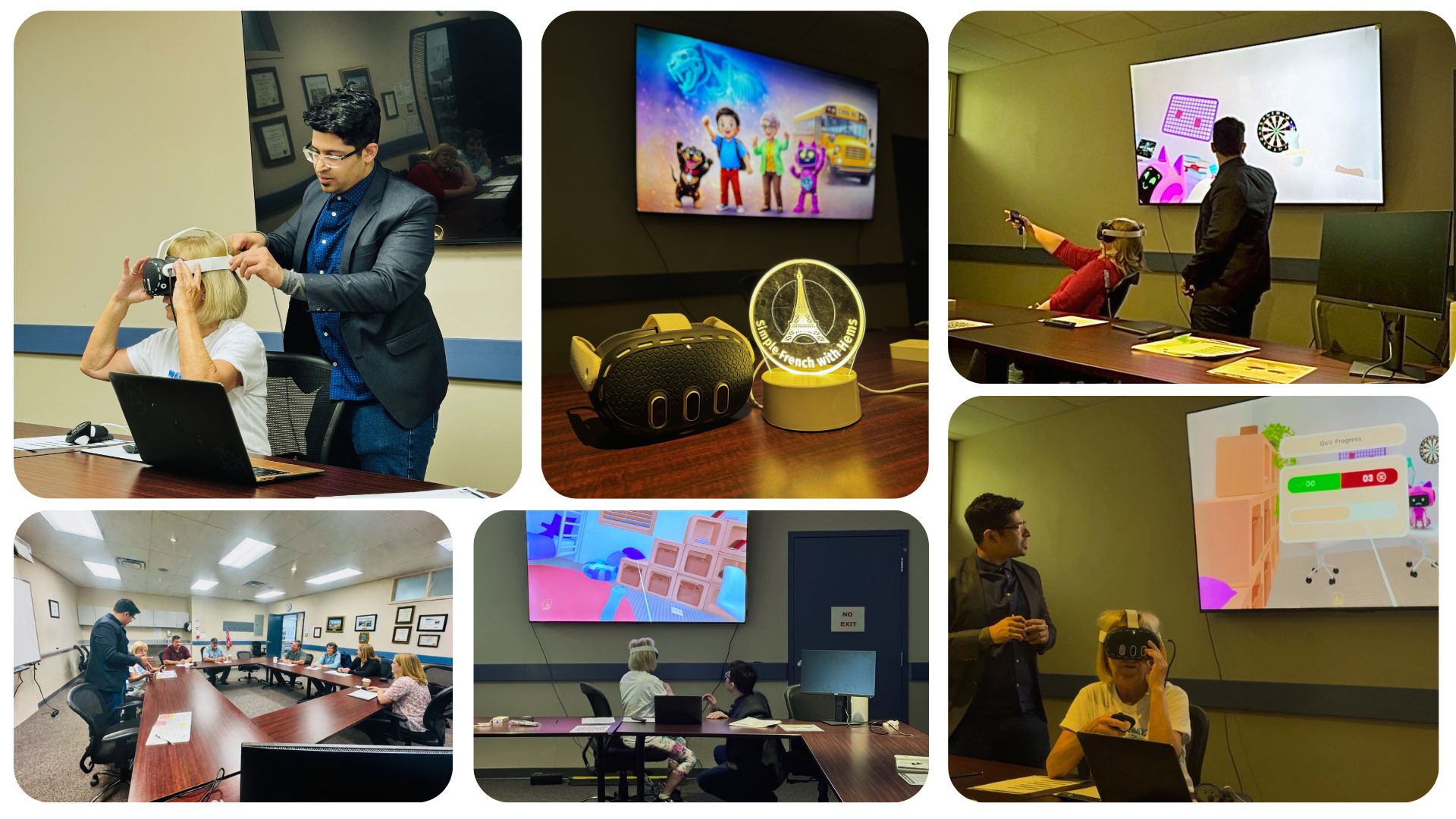
Real delivery, not a staged mock-up.
The SEESA collage shows multiple moments of seated headset use, facilitator support, shared-screen visibility and group participation.
Past SEESA workshop | April 2026
Archived material from an earlier SEESA workshop. It documents how the senior-focused format was publicly presented at the time; the date on the poster is historical.
Recognized within Alberta's innovation ecosystem.
The Immersive Mind & Memory Program (IMMP) has also been demonstrated in public technology and innovation settings. The Alberta Catalyzer profile provides independent ecosystem context for the company and product direction.
Inside real Immersive Mind & Memory Program (IMMP) pilot sessions.
These are live workshop and pilot-session photographs from Simple French with Hems.
They show participants trying Immersive Mind & Memory Program (IMMP) with facilitator support, shared-screen visibility
and guided group delivery.
15 real session photosGuided VR useFacilitator supportLive workshops
Immersive Mind & Memory Program (IMMP) pilot: Simple French with Hems presenting the program during a live guided session.Guided headset use: a participant experiences Immersive Mind & Memory Program (IMMP) during a Simple French with Hems pilot session.Group workshop: participants gather around a Immersive Mind & Memory Program (IMMP) activity led by Simple French with Hems.Live demonstration: Immersive Mind & Memory Program (IMMP) is delivered with facilitator support during an in-person pilot activity.Shared-screen visibility: Immersive Mind & Memory Program (IMMP) content is displayed for the wider group during a live workshop.Facilitator-led delivery: a Simple French with Hems session is guided beside the shared Immersive Mind & Memory Program (IMMP) display.Guided workshop context: participants follow Immersive Mind & Memory Program (IMMP) content together during a Simple French with Hems session.VR plus group visibility: a live Immersive Mind & Memory Program (IMMP) pilot combines headset participation with a shared view for the room.Shared participation: participants can follow a Immersive Mind & Memory Program (IMMP) pilot through the room display while the activity is guided.Live program presentation: Simple French with Hems introduces Immersive Mind & Memory Program (IMMP) content during a guided workshop.Close facilitator support: participants receive direct guidance while taking part in a Immersive Mind & Memory Program (IMMP) pilot activity.Seated group activity: Immersive Mind & Memory Program (IMMP) can be delivered as part of a guided workshop around a shared activity space.Standing VR option: a participant uses Immersive Mind & Memory Program (IMMP) while standing during a facilitator-led pilot session.Supported interaction: a facilitator stays close to the participant at the Immersive Mind & Memory Program (IMMP) station.Participant interaction: a live Immersive Mind & Memory Program (IMMP) pilot includes direct conversation and facilitator guidance.
How a guided session moves
The headset appears late in the session - not at the beginning.
The existing program structure already moves through listening, writing, drawing, recall, immersive context and conversation. We organize these non-clinical activities through ARS (Active Recall Sessions) and ICLE (Integrated Cognitive Listening Activities), then repeat the material across sessions rather than relying on one-time exposure. This condensed journey shows how those actions can be organized into one guided sequence for older adults, including groups where MCI may be present.
01 | INTRODUCE THE STIMULUS
Start with one unfamiliar prompt.
The facilitator introduces a simple French word or prompt and sets the pace before asking the participant to do anything with it.
Facilitator-ledLow pressure
Comfort remains flexible. The participant can pause, skip or stop the headset portion; the wider activity can continue without VR.
01020304050607
How a guided session moves
The headset appears late in the session - not at the beginning.
The session moves through listening, writing, drawing and recall before a brief immersive station, then returns to group reflection. ARS (Active Recall Sessions) and ICLE (Integrated Cognitive Listening Activities) extend the activity beyond the headset.
01 | INTRODUCE THE STIMULUS
Start with one unfamiliar prompt.
The facilitator introduces a simple French word or prompt and sets the pace before asking for a response.
Facilitator-ledLow pressure
02 | HEAR IT
Listen before being asked to perform.
The participant hears the prompt and gets time to notice the sound before producing a response.
ListeningNew stimulus
03 | WRITE IT
Give the same stimulus a written form.
Writing slows the activity down and turns the unfamiliar word into something visible.
WritingVisible cue
04 | DRAW IT
Connect the prompt to a simple image.
A drawing gives the same unfamiliar prompt another form and a concrete cue to revisit.
DrawingVisual association
05 | RECALL & SAY IT BACK
Turn earlier exposure into an active response.
The participant remembers, recognizes or says the prompt back after several lower-pressure steps.
RecallSpoken response
06 | ENTER VR BRIEFLY
Add immersive context after the groundwork is done.
The headset becomes one short guided station, with the facilitator remaining nearby.
VR contextSeatedGuided
07 | RETURN TO GROUP REFLECTION
Finish by coming back to conversation.
Participants describe, compare and recall what they noticed during the activity and immersive moment.
DiscussionGroup reflection
Comfort remains flexible. The headset can be paused, skipped or stopped; the wider activity can continue without VR.
Choose how Immersive Mind & Memory Program (IMMP) is delivered at your centre.
The same Immersive Mind & Memory Program (IMMP) can begin as a fully managed visit, continue as recurring facilitator-led programming, or move toward a centre-led licensed model after onboarding.
01Start with one visit
One-time facilitated demonstration or pilot
The Immersive Mind & Memory Program (IMMP) team comes on-site, brings the required equipment, prepares the activity and leads the session from start to finish. Your team can observe participant response before deciding whether a larger program is appropriate.
Equipment brought on siteFull facilitator-led sessionComfort supportUseful as a pilot
Your centre: provides the room, participants and one coordinating contact.
Facilitated pilot
02Return on a schedule
Recurring facilitator-led program
For centres that want regular programming without asking staff to operate the technology, The Immersive Mind & Memory Program (IMMP) team can return on an agreed schedule and lead each visit.
WeeklyThree visits per monthMonthlyCustom scheduleThe IMMP team leads every session
Your centre: schedules the group and supports attendance; The IMMP team continues to handle equipment, pacing and facilitation.
Group delivery
03Operate more independently
Centre-led licensed program
A centre that wants more control can discuss a licensed implementation. The IMMP team provides onboarding, staff training, operating guidance, program access and deployment support.
Staff trainingLicensed accessOperating guidesCentre controls the scheduleImplementation support
Your centre: takes on day-to-day facilitation after onboarding; hardware and licensing are confirmed for the deployment.
Facilitator support
Delivery frequency stays flexible
Weekly, several times per month, monthly and other agreed schedules can be planned around participant interest, centre programming, facilitator availability and the institutional arrangement.
Supporting delivery context
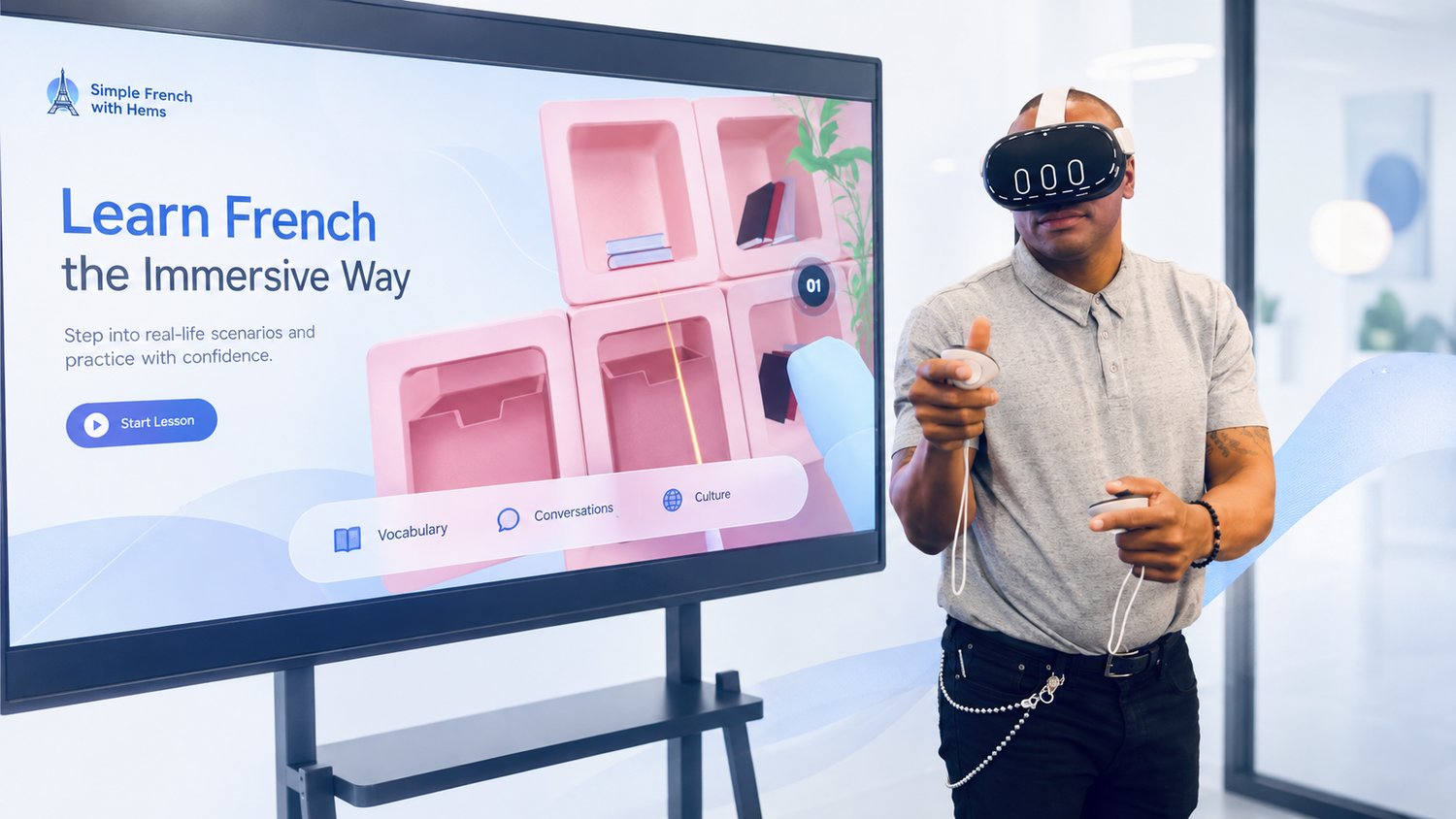
These visuals remain supporting evidence only: platform presentation, immersive flow, pilot delivery, group participation, shared-screen visibility and hands-on setup support.
Immersive Mind & Memory Program (IMMP) platformImmersive learning flowFacilitated pilot | EdmontonGroup activityShared-screen visibilityHands-on facilitator supportParticipant setup support
Your staff do not need to teach French or operate VR.
Your centre provides the people and the space. The IMMP team brings the equipment, activity structure, facilitator and practical technology education to you. The program is designed so a senior or community organization can host it without hiring specialized teaching or VR staff, and older adults do not need to travel elsewhere to access the experience.
01
No French teacher requiredYour staff are not responsible for vocabulary, pronunciation or grammar.
02
No VR operator requiredHeadset setup, fitting and guided use are handled as part of delivery.
03
No special VR room requiredA normal program room with chairs, a table and standard power is usually enough.
Your centre provides
Four simple hosting inputs.
The centre keeps logistics light and familiar.
01Room & seatingA quiet room with chairs and a table. No special layout is required.02Standard powerOne ordinary wall outlet within easy reach of the session area.03Participant groupAbout 6-8 people per round is usually the best experience.04One staff contactA coordinator for scheduling and a simple day-of check-in.
01020304operational handoff
The IMMP team handles
We bring and run the program.
The parts your centre does not need to organize internally.
01Equipment & headset setupThe IMMP team brings the required equipment and prepares the headset for the session.02Fitting & guided VR useHeadset fitting and guided participation are managed with the participant.03Activity structure & promptsThe session arrives with a defined activity structure rather than asking centre staff to build one.04Facilitation & pacingThe facilitator leads the session and manages participant pacing from start to finish.
What this looks like in practice
It can run in a normal community room.
The participant can remain seated while the facilitator manages the headset and follows the activity. A shared display can help the wider group stay involved.
Complimentary AI literacy can be delivered alongside IMMP.
We also help older adults understand the AI tools they increasingly encounter in daily life. The objective is practical literacy and safer recognition of synthetic media - not technical complexity.
See how voice cloning can imitate a person's speech.
See how face cloning and synthetic video can imitate a real person.
Explore simple creative examples, including generating a song with a participant's own voice.
Learn practical cues for asking whether a voice, face or message may be AI-generated.
Support practical AI literacy for older adults in Canada without requiring them to travel to a separate technology program.
Hardware deployment
Three ways to access the headset environment.
Meta Quest 3Meta Quest 2
The headset is the delivery platform; Immersive Mind & Memory Program (IMMP) provides the program structure around it. Centres can use facilitated on-site equipment, paid rental, or licensed deployment to compatible headsets they already own.
01Fully managed
Facilitated on-site equipment
Our team can arrive with configured headsets, prepare the equipment, support fitting and use, run the activity and collect the equipment again after delivery.
Best for: centres that want a fully managed pilot or recurring facilitated program without maintaining their own VR equipment.
Pilot readyNo fleet maintenanceFacilitated
Immersive Mind & Memory Program (IMMP) headset delivery
Facilitated delivery01 / 03
Equipment arrives with the program.Headset fitting, guidance and the session itself stay under facilitator control.
02Temporary access
Paid equipment rental
Organizations that need headsets provided for the Immersive Mind & Memory Program (IMMP) for a defined period can arrange a paid rental, with the fleet size, rental period and support scope agreed in advance.
Best for: centres that want temporary access without purchasing or permanently maintaining a headset fleet.
Defined periodImmersive Mind & Memory Program (IMMP) equipmentPlanned support
Temporary headset access
Equipment access02 / 03
Use the equipment without owning the fleet.Rental gives a centre temporary access while keeping setup and support requirements defined.
03Centre-owned fleet
Licensed deployment to centre-owned headsets
If a centre already owns compatible Meta Quest headsets, The IMMP team can discuss licensed software access, an authorized installation package and setup guidance for the centre's own equipment.
Best for: organizations that already have a headset fleet and want to integrate Immersive Mind & Memory Program (IMMP) into their existing technology environment.
Centre-owned fleetLicensed accessSetup guidance
Licensed headset deployment
Licensed deployment03 / 03
Use compatible equipment already on site.The Immersive Mind & Memory Program (IMMP) can be integrated into an existing Meta Quest environment through an agreed organizational deployment.
Hardware access is flexible. The program standard stays consistent.
Whether equipment is brought on site, rented or deployed to centre-owned headsets, The Immersive Mind & Memory Program (IMMP) remains centred on guided participation, facilitator support and a structured older-adult activity.
Equipment route, licensing scope and support level can be defined with each organization before deployment.
Program record
For a recurring series, you get a program record - not just an activity.
A recurring series can include simple records of attendance, activity exposure, session feedback and delivery adjustments. For centres serving older adults with MCI or other cognitive concerns, the record can help staff compare participation and engagement from earlier to later sessions while remaining strictly non-clinical. The goal is a useful centre-facing overview without turning the program into a medical assessment.
What gets recorded first
01
Participation
Attendance, willingness to take part and return participation across scheduled sessions.
02
Activity engagement
Whether the participant listens, speaks, recalls, recognizes and responds during selected activities.
03
Delivery adjustments
Notes on pacing, activity changes or session-level adjustments that may improve the next visit.
04
Session feedback
Participant comments, facilitator observations and organization-level feedback where appropriate.
These session-level notes build into one centre-facing record.The report comes after the individual observations, so the reading order stays clear: record first, summarize second.
What the organization receives
Not a cognitive assessment.
Participation records or progress summaries are program-management tools only. They are not diagnostic measures, clinical cognitive tests or evidence of treatment outcomes.
Program record & privacy.
The exact information recorded depends on the institutional arrangement. Records are intended for program administration and facilitation rather than clinical assessment.
Review Privacy Policy ->
Who it is for
Designed first for senior and older-adult settings.
Immersive Mind & Memory Program (IMMP) is intended for organizations looking for a guided, social and novel activity for older adults - including settings that serve people with mild cognitive impairment (MCI) or age-related cognitive concerns, especially where independent VR use or formal language study would not be the right format.
01
Senior centres
Member programming, technology days and recurring learning or engagement activities.
Member programmingTechnology days
02
Retirement communities
Resident programming delivered on-site in a familiar communal space.
On-site deliveryFamiliar setting
03
Community organizations
Small-group programming for associations, nonprofits and local community groups.
AssociationsSmall groups
04
Cultural & learning groups
Programs interested in language, novelty, conversation or technology-supported participation.
LanguageNoveltyConversation
AFTER THE SETTING, CHOOSE BY PURPOSE
Why choose Immersive Mind & Memory Program (IMMP)
Selected by purpose, not only by age.
An older adult who wants a game-based French-learning experience can still use the separate our separate VR French Game. Immersive Mind & Memory Program (IMMP) is for organizations or participants whose goal is guided cognitive and social engagement.
Separate Immersive Mind & Memory Program (IMMP) experience
Looking for the Youth & Adults French VR Game?
That experience is focused on immersive French learning, spoken interaction and game-based tasks.
Open the official six-page centre guide for internal review, staff briefing and program planning. It includes participant activities, comfort guidance, centre requirements, headset deployment options, working checklists, research references and decision-ready notes for senior-centre teams.
01
Centre planning checklist
What the host organization needs to review before scheduling or deployment.
02
Participant & comfort briefing
Key participation, supervision and comfort considerations for older adults.
03
Headset deployment
Equipment access, setup routes and practical implementation notes.
04
Research + decision checklist
Research references and decision-ready questions for centre teams.
Six pages designed for internal review.
The guide can be shared with centre leadership, program coordinators or staff before a pilot, recurring series or deployment discussion.
6 full pagesCentre-facingPlanning notesDecision support
By using this website, you agree to our use of cookies. We use cookies to provide necessary site functionality and provide you with a great experience.
Thank you!
Your message has been successfully sent
Thank you!
Your form has been submitted. Please check your email for a copy of your responses. If you're accepted, you'll receive an email with a link to checkout.
Could not add item to cart
Write a Review
After purchase you are sent an email receipt which includes your download page link. Please visit that download page to submit a review for this product.